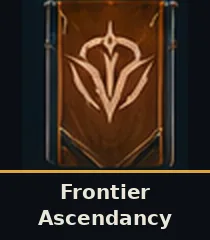
Frontier Ascendancy
Ascendancy burst—free sky ahead. Chart your own Break, claim the burn, leave Concord grids choking on our wake. Striders, Rangers—outrun the ledger. No permit on glory. If the Lattice flinches, we write the next map in Machlight.
Distance is freedom. The Frontier settlements were founded far from any node and learned to live with long transit, thin supply and no help coming. The compact that became the Ascendancy is a mutual aid agreement, not a government, and its members treat every central authority as a toll booth.
Never hold ground you can outrun on. Frontier companies fight by route: get in faster than the defence can react, take what the mission needs, leave by a line nobody has closed yet. They accept casualties in exchange for tempo and consider a slow victory a kind of defeat. Their training emphasises reading unfamiliar terrain at speed, because a Frontier operator is rarely fighting on ground they have seen before.
Weathered ochre and rust-red over bare alloy; high-visibility orange strips on the Drive housing because Frontier crews do not expect to hide. Silhouette is lean and forward-leaning, the Drive carried low on the spine, with external cells strapped where they can be swapped fast. Equipment feels field-repaired: mismatched panels, hand-cut stencils, straps over latches. Sound is loud, rattly, honest.
The Strider is a Frontier design. It is what you build when the mission is "cross forty kilometres of unmapped valley, take one thing, come back," and it has been copied by every bloc since. Frontier companies still run more Striders than anyone and think of the Ranger as a Strider that lost an argument with a quartermaster.
Two Runners leave the same base on different Breaklines at the same moment; the one the defence commits to becomes the decoy. The chain: the team must first spot the defensive sweep pattern (a scout's damage mark or a sensor read, 3–5 s of information), then both Runners close on Glide, then the escort softens whichever interceptor turns, then one Runner secures the Core and leaves. The enemy can break the chain at every link: deny the spot, intercept both routes, kill the escort, or hold a reserve at the Core Station. Nothing about it is one button.
Callsigns and insignia
Insignia are described, not drawn. The archive records what a mark means; the paint is the company's business.
- Kestrel-Nine
- a chevron of three descending arrows, hand-stencilled, meaning "downhill, always."
- Longtail
- a single horizontal line broken once near the right end; the break is the Runner.
- Dust Ledger
- a Frontier company insignia: a tally mark of five strokes with the fifth drawn as a Burn Arc. Companies count their runs, not their kills.
In this voice: The Rail. In the field: operations where this bloc's chain is run.