MB-PRM-01The Vector Lattice
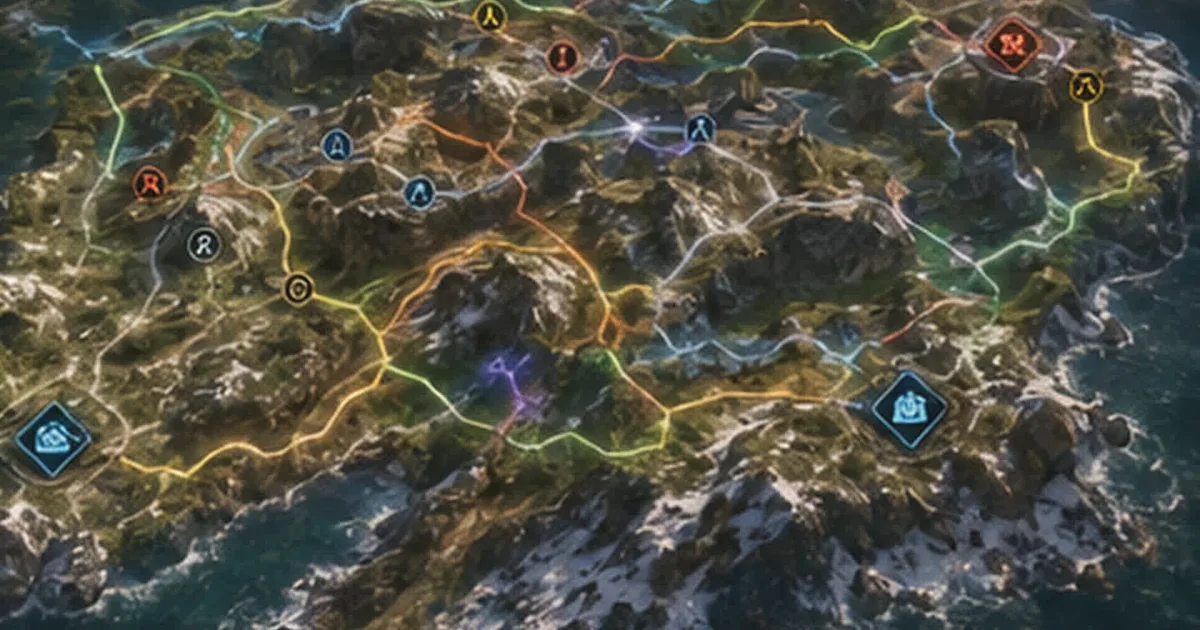
The Lattice is a lattice in the literal sense: a mesh of standing gravitational gradients that threads through interstellar space between a few dozen stars. A hull carrying a field coupler can "settle" into a gradient and be carried along it at a fraction of lightspeed with almost no expenditure of reaction mass. Transit along a Lattice strand is not instantaneous, months between neighbouring systems, but it is cheap, and cheap transit is what made settlement possible.
Nobody has found who laid the Lattice or whether anyone did. The consensus survey position is that it is a natural structure, an artefact of how mass distributed itself in this region of the galaxy in the deep past. The minority position, which no faction holds officially and every faction quietly funds research into, is that a structure with that regularity was made. The Lattice is anchored at intervals by control nodes: compact mass concentrations, usually a captured planetoid, around which a strand's gradient is unusually steep and stable. Control nodes are the only places where a strand can be modulated from the outside. Whoever holds a node holds the strand.
MB-PRM-02Mach Drives
A field coupler on a ship weighs several hundred tonnes. The Mach Drive is the same principle cut down to something a person can wear on the spine.
A Drive generates a small, tightly shaped inertial field around its wearer. Within that field, the wearer's body is coupled to the local gravitational gradient rather than to the surface it is standing on. The practical consequences are the ones that matter to a soldier:
- The body survives acceleration. Forces are distributed across the field envelope rather than the skeleton. A Machborne operator can take vertical thrust, sudden vector changes and hard landings that would pulp an unprotected person.
- Terrain contact becomes optional. With the field set to its low-coupling state, the operator is barely attached to the ground. Friction drops to almost nothing. A slope becomes a ramp; a bowl becomes a launcher. The operator glides.
- Thrust is cheap but finite. The Drive can shape its own field to push against the local gradient, which is what a Machborne calls a burn. It draws on the Drive's energy cell. The cell recharges, but never fast enough for what the operator wants to do next.
The Drive does not make the operator fast. Terrain makes the operator fast; the Drive makes it possible to use terrain without dying. That distinction is the heart of Machborne doctrine and the reason the wars are fought on foot as much as from orbit.
MB-PRM-03The Machborne
Drive operation is a trained skill with a washout rate that the foundries do not publish. An operator has to learn to read a landscape as a sequence of gradients, to feel the moment a slope will give velocity back, to commit to a burn early enough that it matters and late enough that the cell will still be there for the landing. Those who learn it are called Machborne. It is not a rank, a caste or a bloodline. It is a job, and most who hold it are ordinary people who happened to be good at it.
The word started as a foundry certification stamp, Mach-borne, rated for Mach Drive operation, and became an identity the way any dangerous trade's name does.
MB-PRM-04The Break
Roughly forty standard years ago, a strand of the Lattice near the Halden node stopped behaving. Transit times lengthened, then became unpredictable, then hulls stopped arriving at all. The gradient did not vanish; it became turbulent, with local field values that surveys still cannot model. The affected region expanded along neighbouring strands over about a decade and then stabilised at its current extent: eleven inhabited systems cut off from the rest of the Lattice, and a boundary zone where the field is usable but hostile.
That region is The Break. Inside it, Mach Drives behave strangely: the field couples harder, burns push further, terrain gives more back. Technology recovered from within The Break, modified couplers, cells that hold more than their rating, Drives that were inside when the failure happened, is the most contested material in known space. Whether anything inside The Break caused it is the question the wars are actually about.
MB-PRM-05The Mach Wars
When transit fails, the map redraws itself. Systems that were three months from a foundry were suddenly years from one or cut off entirely. Governments that had been provinces of larger unions found themselves alone; unions that had held together through cheap transit fractured into the four blocs that still exist. Every one of them needs Drive foundries, control nodes and Break salvage, and none of them can spare a fleet to take them, so the wars are fought by Machborne companies: small, fast, expensive units contracted, loaned, or raised by guilds and dropped onto contested ground.
The engagements MACHBREAK depicts are these: proxy actions for a node, salvage raids into The Break's boundary, guild contests sanctioned by all four blocs because a sanctioned contest is cheaper than an unsanctioned war, and training simulations run on captured battlefield telemetry. A match is one of those, not a war. The war is the thing the match is a fragment of.